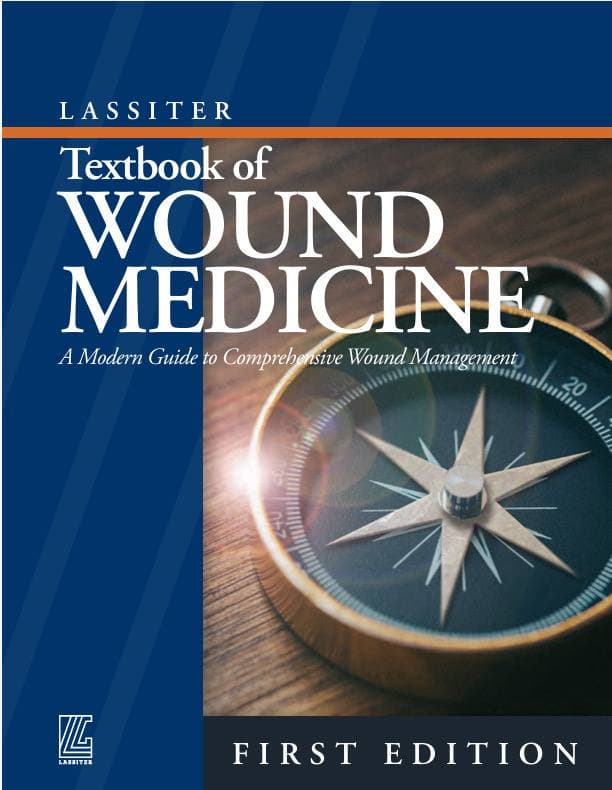
First Edition
Textbook of
Wound Medicine
A Modern Guide to Comprehensive Wound Management
By Lonnie Lassiter, MD
A Physiology-Centered Framework
Chronic wounds fail to heal because of unaddressed biologic barriers, not because of insufficient product use. This textbook reframes wound care around wound biology — not dressings.
The Problem With Product-Driven Care
Chronic wound documentation is frequently fragmented, emphasizing surface appearance and dressing selection over underlying wound biology. This obscures physiologic reasoning, weakens continuity between assessment and plan, and complicates demonstration of medical necessity.
Three Phases of Healing
Every wound is classified by its active biologic phase — Cleaning, Building, or Closing — based on objective wound-bed findings. Interventions are then selected to match the phase the wound is actually in, not the dressing category a clinician prefers.
Local & Systemic Impairment Drivers
At every visit, local barriers (pressure, edema, infection) and systemic barriers (perfusion, metabolic status, nutrition) are identified and documented. This makes delayed healing a visible, addressable problem rather than an unexplained one.
Defensible Medical Necessity
Organizing care around phase and impairment domains produces documentation that is complete, internally consistent, and clearly justifies advanced therapies. Regulators see reasoning; providers see continuity; patients see progress.
I strongly recommend this book as a reference for all who treat wounds.
— Paul Kim, DPM
The Model
Every wound encounter is structured around two questions: what phase is the wound in, and what is keeping it there?
Phases of Healing
Cleaning
Remove devitalized tissue, control bioburden, and prepare the wound bed for productive healing.
Building
Support granulation, matrix formation, and tissue development through the active reparative phase.
Closing
Drive epithelialization, contracture, and durable closure of the wound surface.
Healing Impairment Domains
What the wound is sitting in
- • Pressure & offloading
- • Edema & venous congestion
- • Infection & bioburden
- • Moisture balance
- • Mechanical trauma
What the patient is bringing to it
- • Perfusion & arterial supply
- • Metabolic & glycemic status
- • Nutrition & protein stores
- • Immunologic competence
- • Medication effects
Why It Matters
Chronic wound care is fundamentally a problem of impaired biology rather than product selection. This framework reframes chronic wound management as a dynamic process of biologic problem-solving — not a static process of product selection.
About the Author

Lonnie Lassiter, MD
Wound Care Specialist
Lonnie Lassiter, MD has spent his career caring for patients with complex acute and chronic wounds. This textbook is the distillation of that work — a practical reference grounded in daily clinical experience, designed for the clinicians who actually sit at the bedside.
Get Your Copy
Available in digital and hardcover formats. Choose the edition that works best for you.
Digital PDFs are delivered by email within 48 hours of purchase.
PDF Download
Delivered within 48 hours
- ✓ Full textbook PDF
- ✓ Searchable & printable
- ✓ Delivered by email
Hardcover
Ships in 5–7 days
- ✓ Premium hardcover
- ✓ Full-color illustrations
- ✓ PDF included